

12 For now we see through a glass, darkly; but then face to face: now I know in part; but then shall I know even as also I am known.
1 Corinthians 13:12 (KJV)
“By What right,” Akiba protested, “do you presume to call my attitude blind? Belief need not be unseeing. Is it a darkening of counsel to admit that truth is not a matter of the mind alone, but of the heart and experience also? Since it cannot be obtained by reason unaided, faith is indispensable both as a base on which thought may stand, and as a checkrein when logic goes astray.
“He who wishes to trace a circle must first select out of all space a point about which to draw it. The choice of the point makes possible the line which circumscribes it. The utility of the circle in practice will determine ultimately whether the point has been well placed. So with faith. It is the axis about which we move-an axis that must be posited as an act of will. The fate of man determines whether he has located it properly. That is all I am saying-that belief is the beginning, that it may be tested by experience, but that it must exist, or nothing can be.”
As a Driven Leaf by Milton Steinberg
“You can never know everything, and part of what you know is always wrong. Perhaps even the most important part. A portion of wisdom lies in knowing that. A portion of courage lies in going on anyway”
Robert Jordan in Winters Heart
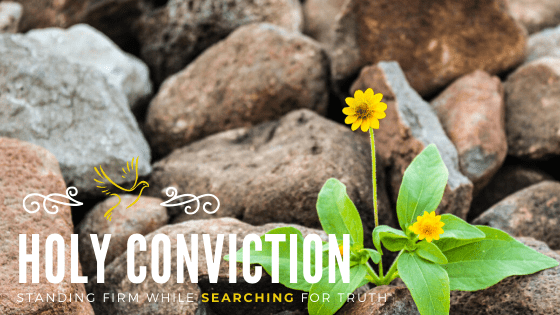
Holy Conviction is to stand on faith. It is to acknowledge an incomplete and imperfect knowing but it is to cast the core of your identity and faith on something or some one. As a Christian it is to place the core of our identity in the knowledge of a loving God and the willingness to call God Lord. It is to stand on a firm foundation. It is not to walk blindly. We test that foundation daily by reflecting through experience and reason as to the how well placed our foundation is. Blind conviction is pretending our knowledge can be perfect and failing to take note when experience and reason both contradict our core beliefs. Science is not an enemy to God. Yet even science requires faith. At its deepest roots it requires the acknowledgement that there are self-evident truths. Truths so essential and obvious that though they cannot be proven we can trust them as the building blocks to gain more truth. The scientific method is based on the idea of universal laws. An idea that started from the belief in an immutable and unchanging God. The very idea that there is things we can know or at least predict with utility how things will happen based on enough relevant knowledge assumes that the universe acts consistently and according to consistent laws even if we don’t know them. Other than the utility of these beliefs though there is nothing that requires nature to work in a universal fashion. There exists theories at least and as it is sometimes coined the idea of a multiverse or areas of creation in which the laws of nature might well be different from our own. This is of universal laws are an observed truth not a necessary or even provable truth.
Faith or religion does the same for us in terms of people as science does for us in nature. It is a beginning. It is a set of hypothesis based on self evident, experienced or reasoned truths. We know a faith is well placed when it allows us through experience to see real and positive change. We don’t as a Church (universal) believe blindly. We regularly argue, hypothesize and experiment with putting our faith into action. We are regularly reasoning on matters of Theology and re-interpreting what we know based on development of scientific knowledge reveals about the physical world. I say scientific and not secular here purposely. That is because I believe all truth whether about the physical world or the spiritual world belongs to God. I think there is plenty of reason to separate spiritual truths from physical ones in the course of general study. While, I think there may be some overlap as they ultimately emanate from the same source there is not the same interaction. Especially if things such as prayer can alter the physical world through miraculous means, then it would hardly be able to be quantified or proven through scientific means. If by miraculous we mean contrary to or in subversion of the natural order and laws then it would be almost impossible to prove. It wouldn’t be able to produce a simple test of replication. In order to do that you would not only need to duplicate the physical realities of the prayer but the spiritual realities. It is also simple hard to prove a miracle because our scientific knowledge is limited. Plenty of things happen all the time over which we have no ability to predict. It is hard to say if those things then are because of the limit of our knowledge, because they are random, or because they are miraculous. Take the weather as an example. We are much better able to predict the weather now but we can hardly predict it with a hundred percent accuracy. Is that because there is a certain element that is random, is that a limit to the conditions we can reasonably observe, or a lack of knowledge in theory? Possibly all three. Want to go for a real head spin, simply ask scientists is there is or isn’t any true random occurrences in the universe.
So where does that leave us, well just as scientists re-evaluate as new evidence arises so should we. We also, however, have thousands of years or experience and reasoning which has taken place in the church. As such when we stand on that tradition we stand on a tried and tested foundation. Scripture in particular is an excellent example of this. We continue to read it and use it as a core of our teaching because we find it useful. We find it true. There is a reason it is called the living word. When I read it I feel a connection and deepening which I find few other places. It serves me well. When we rely on God we stand firmly on the Truth. We rely on God as God has been revealed to us. In the scriptures and in the church. We we stand on these pillars we can speak with authority on issues of faith and morality. We should testify to the Truth to the best of our ability. We must also be careful not to impart our own motives onto God. We must remember that we don’t see perfectly. Our God is not only a true God but an Infinite God. We can know the deeds and mind of God only so far, at least in this life. We must also remember that as God is infinite, there is always room to grow in becoming more Christ like. We must constantly test our foundations to make sure they are of God and not of our own making. What is of God will withstand the test of time. No matter how many times examined it will only shine more brightly as if polished to a golden shine. That which does not reside in God but only of our own making though will wilt. It should be burned away and hewn firmly from our foundation.
As such we should hesitate most firmly to speak for God. We should not lead ourselves or others astray. We should not be afraid to say ‘I don’t know.’ It is more healthy for us and others, then when we speak as if we do. Holy Conviction is one that does not pretend to know all but is always seeking to know more of God’s truth. It is a conviction willing to reconsider and re-evaluate as new evidence arises. It is to use the heart and mind God has gifted us to test the things which come to us as truth. God has no fear of being searched out. There is only good in God. We don’t perfectly know right and wrong. We are struggling continually individually, as a society and as the church to know and define the right thing. This does not mean abandoning our beliefs on a whim. This does not mean a relativism in which any may claim a personal truth. Truth belongs to God and God’s truth is universal. It is a truth written on all our hearts. It is what C.S. Lewis refers to in Mere Christianity as natural law. He aptly points out that society, despite arguments to the contrary, generally agrees on the broad strokes of right and wrong. We agree that murder is wrong. We don’t always agree on what is murder and where the line should be drawn but we all agree murder is wrong. We all agree that lying is wrong, though some make exceptions and others don’t. Still we believe the truth is valued over lies.
Knowing we could be getting it wrong at any moment shouldn’t paralyze us. We can only act in the best of our abilities and within the best of our knowledge. God sees our hearts and it matters to god. Motive matters. I believe there is right and wrong. I also believe that motive matters. It makes even our worst actions a little less wrong when we do them in the belief that they are right. I also believe our worst actions and made even worse when we know those actions to be wrong and do them anyway. I believe that we have to act within our best understanding of right and wrong to do the right thing. I believe we have an obligation to attempt to promote and teach what we believe to be right. I just think we need to be careful not to assume we are always right. We should always be searching for God. In the meantime we should continue doing, thinking and learning to the best of our ability.
 The Holiness Blog